
Seung Sahn (1927–2004)
A Korean Zen Master for a Global Age

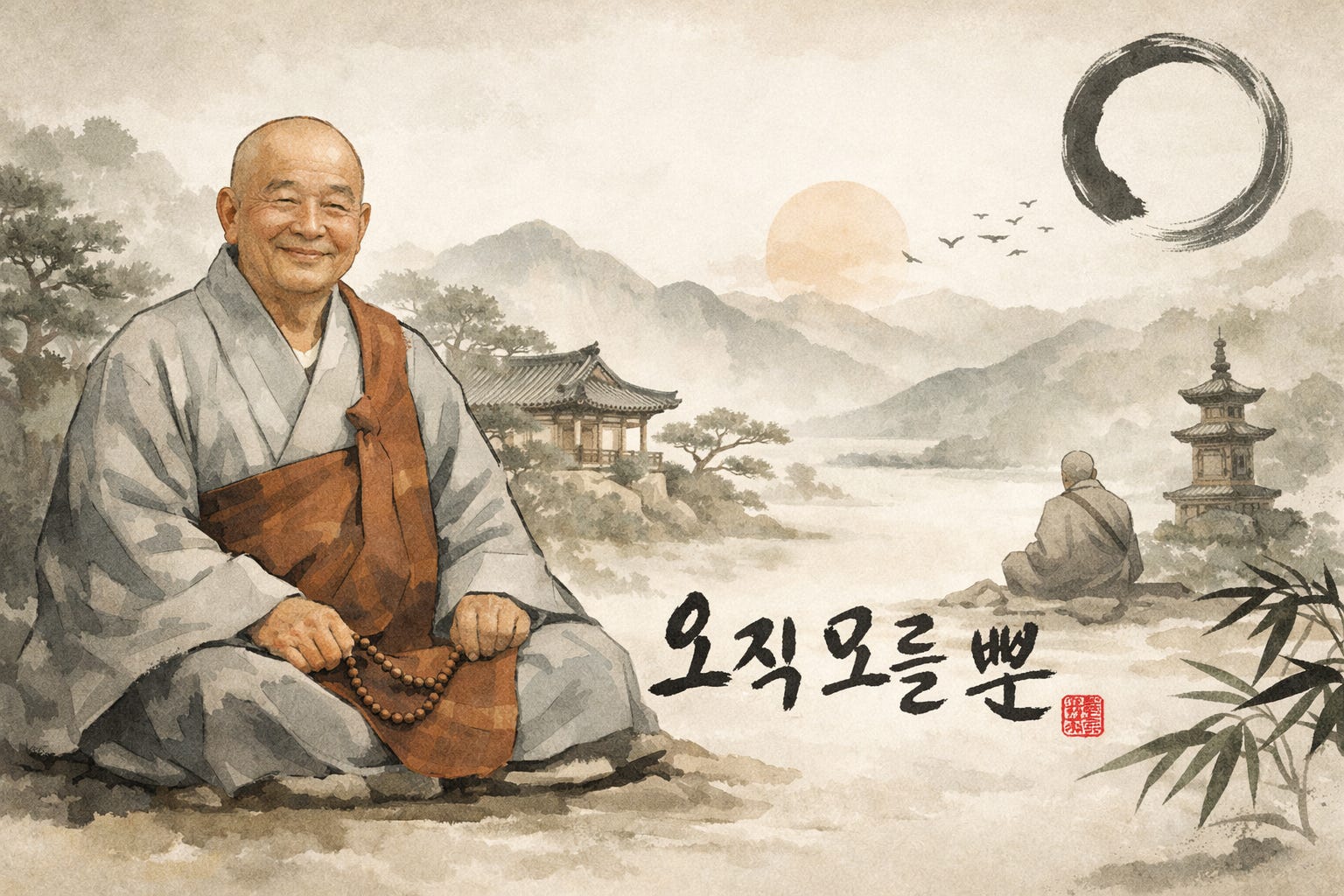
by The Backyard Buddhist
I. Early Life and Historical Context
Seung Sahn Sunim was born Lee Deok-in in 1927 in what is now North Korea, during the final decades of Japanese occupation (1910–1945). That historical fact matters. Korean Buddhism had endured centuries of marginalization under the Confucian Joseon dynasty, and then further suppression under Japanese colonial administration. When liberation came in 1945, Korea was spiritually fractured, politically unstable, and soon divided by war.
As a young man, Seung Sahn was drawn into student activism during the turbulent post-liberation period. He studied Western philosophy at Dongguk University in Seoul, an institution historically associated with Korean Buddhism. The philosophical questions of suffering, injustice, and human nature weren’t abstract to him—they were immediate and lived.
In 1948, at age twenty-one, he ordained as a monk in the Jogye Order of Korean Buddhism, the primary Seon (Zen) lineage in Korea. Within a year, he undertook an intensive 100-day retreat and, according to traditional accounts, experienced profound awakening. His teachers recognized his depth of realization early. By his early thirties, he had already become abbot of Hwa Gye Sa temple in Seoul—an extraordinary appointment for someone so young.
II. Religious Formation in the Korean Seon Tradition
Seung Sahn’s formation was deeply rooted in Korean Seon practice, which traces its lineage through Chinese Chan and ultimately to Bodhidharma, the semi-legendary transmitter of meditation-centered Buddhism to China.
Korean Seon is characterized by:
Rigorous meditation practice (ganhwa Seon, or “observing the hwadu”)
Intensive retreat culture
Strong emphasis on lineage transmission
Direct, experiential realization over scholasticism
Central to Seung Sahn’s method was the use of the hwadu (Chinese: huatou), a critical phrase derived from koans, used to cut through conceptual thinking. The question he most frequently gave Western students was simple:
“What am I?”
Not as philosophy. Not as psychology. As a blade.
He often said:
“Only don’t know.”
This wasn’t anti-intellectualism. It was an invitation into pre-conceptual awareness—a stripping away of identity, role, narrative, and metaphysical speculation. “Don’t know mind” was, for him, the gateway to original nature.
III. Arrival in the West
In 1972, Seung Sahn came to the United States with little English and almost no institutional support. His arrival coincided with a broader wave of Asian Buddhist teachers transmitting Zen to the West, including figures such as Shunryu Suzuki and Seongcheol (though Seongcheol remained primarily in Korea).
Seung Sahn’s approach, however, was uniquely Korean in tone and structure. He began teaching at Brown University and soon established the Providence Zen Center in Rhode Island. From there, the movement expanded.
In 1983, he formally founded the Kwan Um School of Zen, which would become one of the largest international Zen organizations in the West. “Kwan Um” refers to Avalokiteśvara (Guanyin, Kannon)—the Bodhisattva of Compassion. The name signals his orientation: wisdom must manifest as compassion.
IV. Teaching Style and Pedagogical Method
Seung Sahn’s teaching style was direct, sometimes abrupt, often humorous. He used paradox, silence, shouting, and spontaneous interaction in ways reminiscent of classical Chan.
But he also adapted to Western cultural forms. He structured sanghas with clear practice periods, lay leadership roles, and progressive training systems. He introduced the title “Zen Master” (Dae Soen Sa Nim) for teachers who had received full transmission and established a structured kong-an (koan) curriculum.
His core pedagogical principles included:
Don’t-know mind as foundational practice
Clear distinction between thinking and direct perception
Integration of meditation and everyday life
Emphasis on vow and compassion
He frequently said:
“Zen is very simple. What are you?”
And:
“When you keep don’t-know mind, everything becomes clear.”
To scholars of religion, what’s striking is how he preserved classical Seon structure while translating its affective tone into a Western idiom. He didn’t dilute tradition—he recontextualized it.
V. Institutional Achievements
Seung Sahn’s institutional accomplishments were significant:
Founded over 100 Zen centers worldwide
Established monasteries in the United States and Europe
Ordained monks and nuns in Western contexts
Authorized multiple Dharma heirs
Published accessible Zen texts for lay readers
The Kwan Um School developed a hybrid structure combining Korean monastic forms with lay-centered Western sangha models. Retreats (Yong Maeng Jong Jin) were integrated into American schedules. Chanting incorporated Korean liturgy while gradually introducing vernacular translations.
He became one of the first Korean Seon masters to successfully transplant a full lineage into Western soil.
VI. Publications and Intellectual Contribution
Seung Sahn authored and inspired numerous books, including:
Dropping Ashes on the Buddha (1976)
Only Don’t Know (1999)
The Compass of Zen (1997)
The Compass of Zen is perhaps his most systematic presentation. In it, he offers a sweeping overview of Buddhist doctrine—Theravāda, Mahāyāna, and Zen—before cutting through them with the simplicity of don’t-know mind.
Unlike some Zen teachers who minimized doctrinal literacy, Seung Sahn maintained that understanding doctrine was useful—but only if it didn’t become attachment. He could outline Madhyamaka emptiness or Yogācāra mind-only theory, then immediately dismiss conceptual fixation.
His pedagogy balanced structure and rupture.
VII. Controversy and Human Complexity
No scholarly treatment would be complete without noting controversy. In the 1980s, Seung Sahn admitted to sexual relationships with students, which caused institutional strain and public criticism. He apologized and implemented structural reforms within the Kwan Um School.
For historians of religion, this episode reflects broader tensions in the early transmission of Asian Buddhism to the West—issues of authority, charisma, cultural translation, and institutional accountability.
He remained a teacher until his death in 2004, eventually returning to Korea due to health concerns.
VIII. Death and Legacy
Seung Sahn died in Seoul in 2004. His body was cremated according to monastic tradition. His relics were enshrined, and his lineage continues through transmitted teachers across continents.
His legacy includes:
The global institutionalization of Korean Seon
A pedagogical model centered on “don’t-know mind”
A practical, vow-centered expression of Mahāyāna
Integration of lay and monastic practice in Western culture
More subtly, he offered something existentially compelling: a spirituality stripped of metaphysical ornamentation.
Just this.
Just this moment.
Just this question:
What are you?
Concluding Reflection
Seung Sahn Sunim stands as one of the primary architects of Korean Zen’s globalization. Yet his message was disarmingly simple. He didn’t offer metaphysics. He offered inquiry. He didn’t promise transcendence. He asked for sincerity.
In a world saturated with opinion and identity, his teaching of “only don’t know” remains radically destabilizing.
And maybe that’s the point.
Bibliography
Buswell, Robert E. The Zen Monastic Experience: Buddhist Practice in Contemporary Korea. Princeton University Press, 1992.
Kim, Hwansoo Ilmee. Empire of the Dharma: Korean and Japanese Buddhism, 1877–1912. Harvard University Asia Center, 2012.
Seung Sahn. Dropping Ashes on the Buddha. Grove Press, 1976.
Seung Sahn. The Compass of Zen. Shambhala Publications, 1997.
Seung Sahn. Only Don’t Know: Selected Teaching Letters of Zen Master Seung Sahn. Shambhala Publications, 1999.
Sørensen, Henrik H. “Korean Buddhism.” In The Encyclopedia of Buddhism, edited by Robert E. Buswell Jr., Macmillan Reference, 2004.
Kwan Um School of Zen. Official publications and archival materials.