
Searching for the Ox
The Ten Ox-Herding Pictures, Zazen, and the Realization of Enlightenment - A Scholarly Dharma Reflection

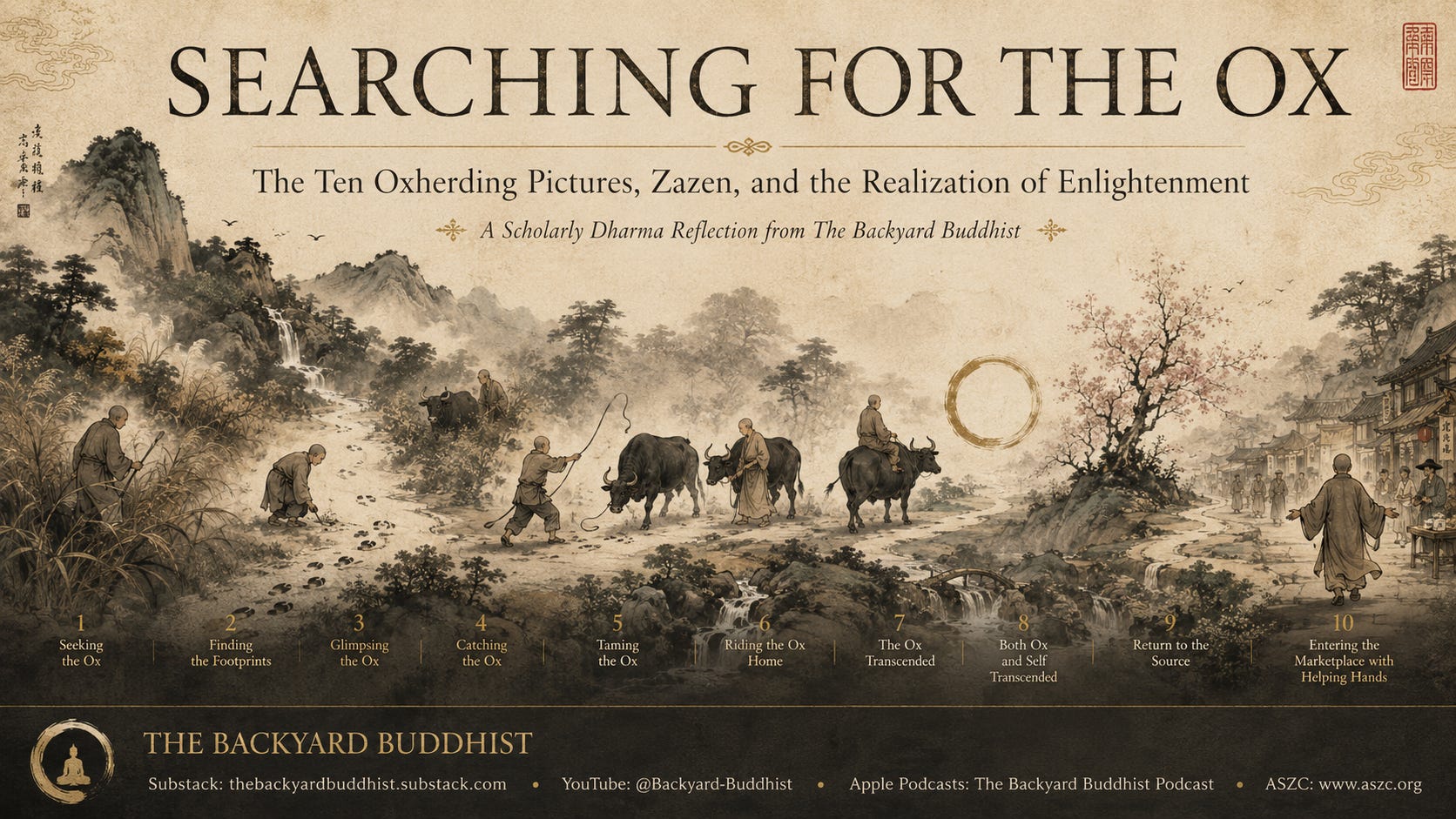
by The Backyard Buddhist
Abstract
The Ten Oxherding Pictures are among the most recognizable expressions of the Chan and Zen understanding of spiritual practice. Through a sequence of deceptively simple images—a herder, an ox, a rope, footprints, an empty circle, a flowering tree, and finally a return to the marketplace—the series depicts the search for awakening, the discipline of meditation, the collapse of subject-object duality, and the compassionate embodiment of realization in ordinary life.
This essay examines the best-known ten-picture sequence associated with the twelfth-century Chinese Chan master Kuoan Shiyuan, known in Japanese as Kakuan Shien. It explores the historical development of oxherding imagery, the symbolic vocabulary of the pictures, and their relationship to zazen and the Sōtō Zen teaching of practice-realization.
Rather than treating the pictures as a rigid ladder of spiritual achievement, this study understands them as a fluid and recurring map of practice. The entire journey—from searching for the ox to entering the marketplace with open hands—may unfold across a lifetime, within a season of intensive practice, or even during a single period of zazen.
Introduction: A Map That Eventually Disappears
Zen often warns us against becoming attached to maps.
A map is not the path beneath our feet. A description of awakening is not awakening. A beautiful explanation of zazen is not the experience of sitting upright in the midst of this body, this breath, and this changing mind.
Yet the Zen tradition has also produced one of Buddhism’s most enduring maps of practice: the Ten Oxherding Pictures.
The images tell a simple story.
A young herder searches for a missing ox. He discovers its tracks, catches a glimpse of it, struggles to capture it, trains it, rides it home, and then forgets it. Eventually, both ox and herder disappear into an empty circle.
But the sequence does not end there.
The natural world returns.
Then, in the final picture, the awakened practitioner enters the marketplace with open hands.
The oxherding pictures are not primarily illustrations of a philosophical doctrine. They portray the transformation of the practitioner’s entire way of seeing and living. They begin with alienation and end with intimacy. They begin with seeking and end with service. They begin with the belief that enlightenment is missing and conclude with the realization that nothing was ever outside the Way.
The pictures can therefore be read as a visual commentary on zazen.
We search for the ox when we first take our seat.
We discover its tracks when we recognize the patterns of thought, sensation, attachment, and resistance.
We glimpse the ox when the ordinary division between observer and observed briefly falls away.
We catch and tame the ox through sustained practice.
We ride it home when practice is no longer primarily a struggle.
We forget the ox when awakening ceases to be treated as an object.
We forget ourselves when even the identity of “the awakened practitioner” is released.
We return to the source when the ordinary world appears just as it is.
And we enter the marketplace when realization becomes compassion in action.
I. Historical Background
The Ox as a Buddhist Symbol
